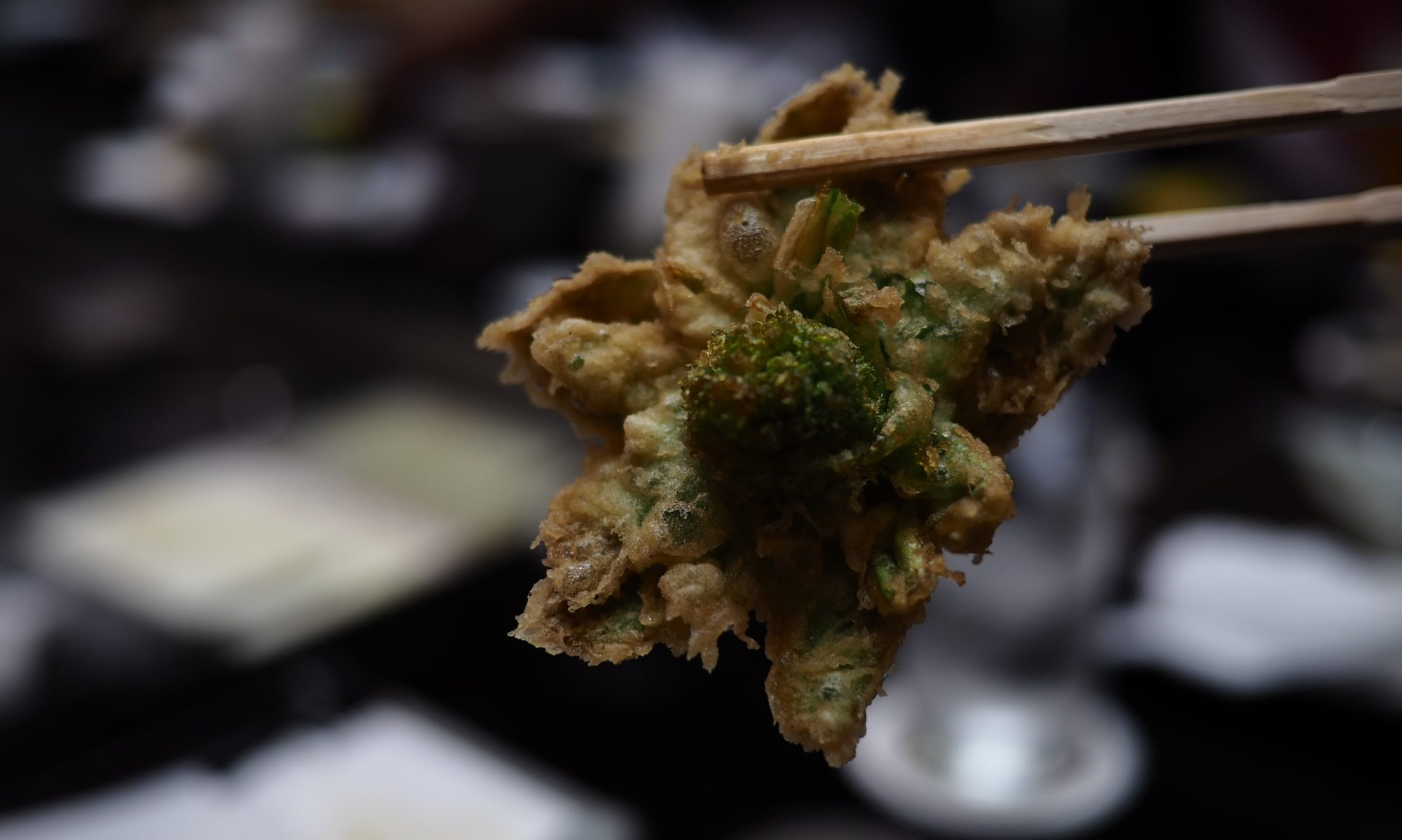
 I didn’t make any quince jelly last year; the quinces on the tree at my Mum’s house came ripe and then dropped off while I was busy getting married and going on honeymoon. This was an ill-considered piece of timing on my part, and resulted in a year of married bliss with no quince jelly. Catastrophe. This needed putting right before we found each other weak and snappish at the lack of sugar, our marriage under intolerable, hypoglycaemic strain.
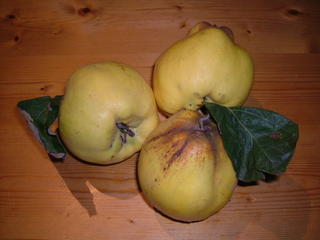
Quinces are a lot like a large pear in appearance; they’re also covered with a soft, furry down. They smell extremely fragrant, but they’re not edible raw; a raw quince is very hard, astringent and bitter. Cooked, however, they change in character completely. They lose their golden-yellow colour and their tart taste, and become pinkish, soft and intensely scented.
When I make quince jelly, I follow Mrs Beeton’s recipe. (There are only a very few of Mrs Beeton’s recipes I would happily cook from, but her preserves are usually excellent, and, of course, preserving was much more important to the refrigerator-free Victorians than it is to us.) It’s very simple – all you need is quinces, water and sugar. She says:
INGREDIENTS – To every pint of juice allow 1 lb. of loaf sugar.
Mode – Pare and slice the quinces, and put them into a preserving-pan with sufficient water to float them. Boil them until tender, and the fruit is reduced to a pulp; strain off the clear juice, and to each pint allow the above proportion of loaf sugar. Boil the juice and sugar together for about 3/4 hour; remove all the scum as it rises, and, when the jelly appears firm when a little is poured on a plate, it is done. The residue left on the sieve will answer to make a common marmalade, for immediate use, by boiling it with 1/2 lb. of common sugar to every lb. of pulp. Time – 3 hours to boil the quinces in water; 3/4 hour to boil the jelly.
(If you prefer metric measurements, use 600ml of juice to every 450g of sugar.)
Quinces are, as I mentioned above, absolutely rock-hard. I sharpened my big cook’s knife until it had an edge that would put a samurai sword to shame, and started to lay about the quinces, helping the task along by imagining the faces of countless enemies on each one. (I bear grudges for decades. It provides me with excellent chopping-fuel.)
 Ripe quinces often have small brown patches inside, as in this picture (they’ll get browner as they sit in your pan and the oxygen gets to them, too). Don’t worry. It doesn’t mean your quince is bad. My Mum, who taught me to make this, always insisted that it’s important that you leave the seeds in, but I do wonder whether she’s confusing quinces with citrus fruits, where the seeds are important in jam-making for the pectin, the enzyme which makes the jam gel properly. I give her the benefit of the doubt and leave them in anyway. I also deviate a little from Mrs Beeton here; I don’t pare (peel) the quinces, having discovered a few years ago that it doesn’t make any difference to the finished jelly; you’ll want to peel them if you intend on making the marmalade (quince cheese) that she mentions, but I’m not intending on doing that; there’s little enough room in my cupboards as it is.
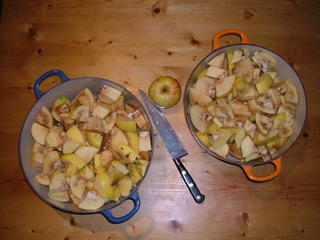 About twenty chopped quinces fill my two largest Le Creuset pans. I’ve plonked my knife and an apple between the pans so you can get an idea of scale – these pans are 26 and 28cm in diameter – this is a lot of chopped quince. The largest pan (the blue one) needs about three litres of water to fill it enough to make the quince bits bob about merrily, the orange pan about two and a half. Simmering for three hours will reduce the quince to a pulp in a gorgeously pink juice, and will scent your whole house with a honeyed, fruity perfume.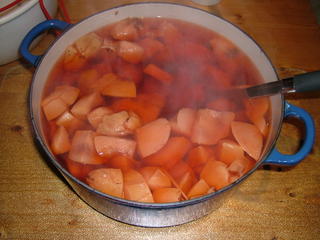
I used to strain jellies by lining a sieve with butter muslin and balancing it precariously on top of the bowl I was straining the jelly into. This year I have seen sense and bought a proper jelly bag from Lakeland. I’m not impressed; the metal stand is coated with red plastic, but the plastic is flaking off the ring around the top as if it’s got a particularly nasty skin disease. I need to be careful that none of it ends up in the jelly.
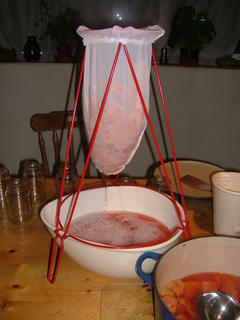 The bowl I want to strain into is too big for the stand. It has to balance on it precariously. My hairy-handed sous chef, Mr Weasel, will need to hold it steady when I put the pulp in the bag.
Quinces contain enough pectin to gel naturally, but the set you get from quince-pectin alone is quite soft. I prefer a harder set, so I use jam sugar, which comes with pectin already added.
The orange pan yields five pints of juice, the blue one six. Bugger, that’s a lot. I don’t have enough jam jars. Today’s most shocking discovery is that it’s cheaper to buy Tesco Value marmalade and throw it away (31p per jar – and this is difficult, because throwing perfectly good food away makes me feel physically ill – but what do you do with six lb of jarless, cheap jam?) than it was to buy my pristine jars and lids from Lakeland (about 50p, including the lid, which has to be bought separately). Mr Weasel, craving jelly, drives to Tesco and buys six jars of sacrificial marmalade.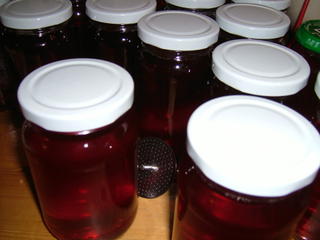 After 45 minutes of simmering (with no lid), 22lb (10 kilos) of quince jelly is ready to go into the sterilised jars. This should be enough to go on crumpets, accompany and glaze roast lambs, drizzle over blue cheeses and make presents for the neighbours until next autumn.
Defnitely a favourite of mine. Mum and Dad area visiting me in Bordeaux this weekend, and I must make sure she brings some out. Nice blog by the way. Very nifty with pics and all. I would say soething rank like Nigella watch out, but I definitely won’t.
I’ll save you a jar for when I next see you. I do, after all, have 22 of the buggers.
Good for you on the Quince jelly front, I have been making it for over twenty years from a recipe belonging to my grandmother. It must be as old as my quince tree – about 100 yrs! Lakeland jelly bag is not as good as the old close woven ticking bag I had for years, the stand is flimsy and the bag lets some fruit haze through. Try putting a sprig of mint or rosemary or thyme into each jar.
Baby food jars are great for jelly and other too delicious products of a country kithchen.
Wow!! We made our quince jelly today, with some fruit from a neighbour’s tree (I think they were Vranja?). It is beautiful . . . so we went and asked her for more fruit and made some quince cheese! More joy! Then . . . we asked Sue for yet more quinces, and made some quince jam! From the small sample we tasted all 3 are really lovely. Waitrose will be stocking quinces anytime soon which is a good thing, we really dare not ask Sue for any more from her tree! Thanks for your inspiration 😉
Thank you – I thought my family was the only ones still making quince jelly. If it is of any help to anyone, this year I diverted from my grandma’s original recipe and used fructose instead of sugar. I have been diagnosed diabetic but could not live without my autumn fix of quince jelly. The fructose is great – you only need two thirds of the amount and it has a lower glycaemic index than sugar. And the jelly still tastes fantastic!
Thank you for the recipe, though I got only 1 pint from 4lb of quince, enough for 2 Tesco golden syrup jars – use it on your porridge instead of throwing away the value marmalade.
Tom
I was given quinces at work but many of them were more under-ripe than i realized. I now have a bowl of horribly bitter quince juice. Is there anything I can do to cut the ‘green’ taste before I make it into jelly?
Oh dear – that’s lousy luck. I hope your friend has some more they can give you. Afraid I can’t think of anything you can do to cut the green taste – you might want to persevere with the jelly and see how it turns out, but I think this is one I’d chalk up to experience!
This sounds great, thanks.
Re-the marmalade – make marmalade ice cream.12oz marmalade and 10 fl oz dbl cream. Beat the marmalade. Wip cream until stiff and fold in. Freeze. As it’s value marmalade I’d add juice from fresh lemon or lime to jazz it up a bit.
I make quince jelly every year from a tree in a park (I use the windfalls). I make some sweet like jam and some not so sweet to have with meat(glaze for duck).
I mix with cooking apples to stretch.
A good variation is to make it spiced with cloves cinnamon and fenugreek. A great Xmas gift
the quinces I had were small but when at Xmas my local organic veg place http://www.homeorganics.ie) donated me some bigger quinces they had going spare I made some preserve (from Mrs Beeton)
I am still doing the cloth over strainer will get a jelly bag.
THANK YOU for the comment about the brown patches. We had been wondering what we were doing wrong!!! We have our own young quince tree in our garden, and last year (bumper crop: 5 enormous fruits) made our first batch of jam. Not as nice as my grandmother’s, so I’m trying again. Flavour was good but texture needs improvement, so thanks for the recipes.
Very good recipe and comments, especially about the crazy price of empty jars. Tesco mint sauce is 15p at the moment. Need new lids for Jam though
Just finishing quince jelly again! found your comments really useful. I keep the local WI in quinces and harvest must be over a hundred each year. Do you know the lifetime of quince trees? mine looks really old.
Going back to the comment about buying cheap marmalade from tescos – don't throw it out! Although it is probably not good enough for toast, it does very well in a chocolate cake. Nigella does a brilliant one called Storecupboard Chocolate Orange Cake in her Domestic Goddess book. Try it – you wont be disappointed!
my wife's diabetic and so i plan to make strawberry jam with fructose this year, does anyone know of a source for fructose in large quantities, 10kg??
thanks
david
help – my jelly bag has twice popped off the stand leaving me stadning in a kitchen splattered with pink juice…..any tips please???
Am making quince jelly for the second year running. My father-in-laws tree is overflowing with fragrant fruit and he’s already supplied the neighbours. I’ve got a black rubbish bag full so I think that will keep me busy for a little while! It’s so easy to make and tastes absolutely fab! I am a quince convert.
han – if you are using a Lakeland jelly bag and stand try using some clothes pegs to hold the bag in place, I did this as I didn’t feel confident the bag wouldn’t “ping” off with the weight of the fruit and it worked well. I’ve just made quince jelly for the first time, looks and smells fantastic but I only got 2 jars from 4lbs quinces. Lots more on my neighbours tree, which fortunately overhangs our garden so I’ll be making another batch.
There must be different types of quinces as the ones I use are not at all downey skinned & have masses of black pips inside. They are rock hard when raw, but do have a distinctively fragrant smell. I’ve just made 9 jars from 4lbs of quinces & 2 cooking apples to make up the (Reader’s Digest) recipe which I’ve used for most of my jam/jelly making. It tastes lovely & is a delicate shade of pale pink tinged apricot.
I’ve used two sorts of ‘quince’ seperatley. One from a bush with thorns, not hairy fruits, little smell, round and very hard. It didn’t go pink so I kept cooking it, too long I think. It went to a pulp and I didnit get enought juice to to make jelly so just made the quince cheese. The second batch was from a tree without thorns, pear shaped and vragrant fruits although there was no fur. They looked just like the ones in the foto’s above. In Holland it’s called a Kwee-pear or Kwee-apple with English translation quince. Have made jelly and cheese from this. How long do I have to leave it before I can eat it. P.S. Thanks for the foto’s
I use a baby muslin from mothercare. I fold the 4 corners and sew them to make pockets. I turn a chair upside down and balance it against something to make the bottom level. I slide the pockets over each chair leg which makes a nice open bag for pouring,put container under and wait. Will never cloud. If bag is too low twist corner bits to bring it up higher
To strain jellies, I use my grandmother’s method – Kim’s sounds like a more modern version! Take a kitchen stool and turn it upside down (nice and stable). Take a strip of muslin or a baby muslin. Place over the bowl you want to collect the juice in, pour in the fruit and liquid, then bring together the corners of the muslin to make a bag. Tie with a long piece of string, and then tie the string to the stool legs so that the bag is suspended over the bowl, which sits safely on the inverted seat of the stool.
I used 3.5lbs of prepared (cored and chopped) quince, 3.5 pints of water. Boiled for an hour, mashed with a potato masher, boiled a bit more. Strained through a colander for just a few minutes, stirring occasionally (not pressing) then strained the juice again through a fine sieve. So, I don’t know how much juice I may have lost by not straining through muslin for many hours, but it saved so much time! Added 1lb 12oz of sugar and boiled until set. It made about 3.5lbs of deep red jelly, lovely and clear – no haze. So, no upside down chairs or stools, no jelly bags and little fuss. But is it any good? I have no idea as I don’t know what to expect of a quince jelly!
The idea from Ralph is definately worth a try for me. My French neighbours have just delivered me about 100 kg of quince (well I did ask for some!!!!) as they would like some jelly, which they have tasted in our house.
I will repost when I know if the new version has worked!
Am really interested to find so many ideas to make quince jelly/jam etc.
Just moved to Provence & inherited small quince tree, FULL of huge fruit.However, can’t find any comments about when to pick them.? It will be my first attempt so also a bit unsure which method to try?
HELP !!
We live in the Vienne so further north than you and have already harvested the quinces. It’s my first time making it so I wasn’t sure when they would ripen, but as they are falling from the tree I reckon it’s time!!!!
I’m using the Readers Digest recipe 2Kgs quince 3Ltrs water juice of 2 lemons , strain it twice then add 750gm sugar to every 1ltr of juice produced
Can one steriliss jars in microwave (quince jelly). Thanks
Afraid I’ve got no experience with doing that – if there are instructions somewhere online on doing it, it’d be great if you could post them here!
why bother with a jelly bag?? Pillow case, tea towel, etc. just grabbed something, rinsed it to get the softner out but dont bother ironing it at high temperature (the juice is gonna be boiled again anyway). Chair upside down on table, elastic bands and one has a very properly function ‘bag’. Also, the fact that it is wet from the rinse tends to reduce the wastage of the bag ‘needing’ to get wet from the juice. A save if you ask me 🙂
Sterilising jars: wash in soapy water, rinse ott, boil lids for at least 10min, jars in oven at about 140-160 C. Fill nearly to the top with jelly
That’s how I do it too. Still waiting to see if anyone’s used a microwave!
Seen as I do not own a microwave am not fussed. Butttt, I think if you fill the jars you’re gonna use half with water, but it on a high setting for 7-10 min, then take them out, chuck the water (use to do dishes e.g.) and start again with more jars. Lids would still in a pan.
Btw, what is it with this fixation on microwaves? We’ve been making jam for hundreds of years without them.
No idea. I don’t own one either. 😉
Quince jelly is lovely, nicely set, dark red and clear!! Wahey, success. And no microwave 😉
Wiped the ‘down’ of the fruit, Top n tailed the quinces, chopped them fairly small (each fruit into +/- 16), left the skin, pips, core. Added water to just not cover the fruit. Simmered until pulp then drain in teatowel. Reheated the pulp that was left over, strained that again and got another 3/4 pint of juice. 1.9L quince juice, 1,43kg granulated sugar (as per article above) and 60ml of sieved fresh lemon juice.
Hey presto!
Now, I know I’m a year late to this ! but am having my first bash at Quince (japonica quinces) jelly. Having spent alot of time in Spain and Portugal I was severely tempted to try membrillo (SP) or mermelada (PT) but, given that the first instruction was ‘peel and core’ the fruit and just chopping the damn thing nearly caused the loss of a hand – I gave up immediately and decided on jelly. Now I’m wondering if i’ve made a mistake. I have very little juice from over four pounds of fruit and a helluva lot of perfectly good pulp just sitting in the muslin. Somewhere back in about 2008 (above) someone said about hating waste – me too. So, I think I could have a couple of options – reunite the whole lot and push it through a sieve and still go with the membillo/mermelada or chuck the pulp and go with the jelly. OR could I have both? why not push remaining pulp through sieve and make cheese anyway ? Any thoughts? Does everyone else just chuck the pulp ? By the by ladies and gents – I find loitering near bottle banks quite handy for picking up recycled jars ! but really ! just prime your friends and you’ll have their jars from now till kingdom come – just recycle any you don’t need. Sustained a nasty injury reading about buying the things !! Good lord whatever next! As for jelly bags ! Good old muslin, string, wooden spoon and a bucket – your granny would be turning in her grave ! Tsk tsk !Px